
1·
17 minutes agoThey’re talking about films that are over 3h30 in runtime. There’s real data showing that films are creeping up in length
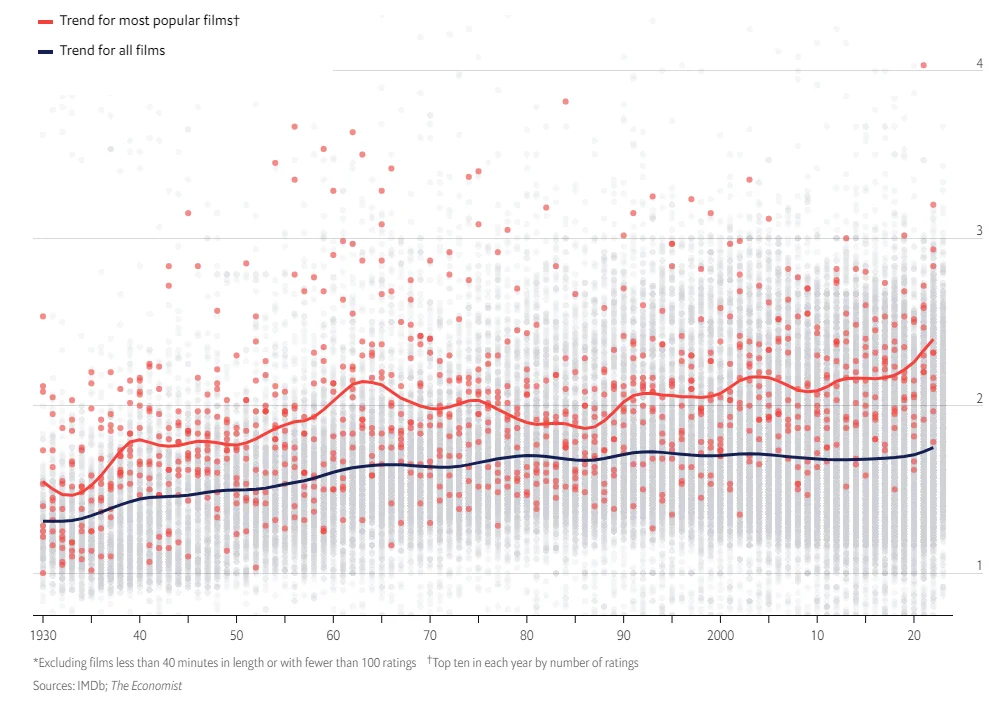
They’re talking about films that are over 3h30 in runtime. There’s real data showing that films are creeping up in length
This exact scenario has happened to me so many times it makes me want to find whoever’s responsible and force them to use the goddamn site.

If /i/ is the opposite of /u/ due to front/backness, what happens to central vowels? If you also flip height, what happens to schwa?
You could “flip” consonants in a similar kind of way; place and manner of articulation are essentially two linear dimensions (with place being how far forward or back in the mouth the consonant is articulated, and manner being how much the airstream is interrupted - but this is approximate). In this scheme, /b/ would become /ʔ/. There would be some difficulty because not all consonants can be made or distinguished in practice.
Is this cipher supposed to be spoken or written? You will have difficulties either way: If spoken you will end up with sounds not in the English sound inventory, so they will be hard for speakers of English (or probably: of any single particular language) to say. Some pairs of sounds that are distinct in English will be mapped to allophones. If written you will end up with sounds where there is no standard way to denote them except with IPA, in which case you’ve really made an alphabetic substitution cipher where you:
In this scheme it doesn’t actually matter that you’re “flipping” the sounds; the transformation could be anything and it would be encoded, decoded and cryptanalysed in the exact same way.
I like the pubes - special attention to detail.
Apparently it was likely a drinking vessel? So it’s like that willy mug you get your friend for her hen do.

I looked into this (just on Wikipedia). Before granting Mauritius independence, the UK split the territory into Mauritius and the British Indian Ocean Territory in order to have a place to put the base that’s there now. But the UN takes a dim view on such shenanigans and tends to say that such territories should be reconstituted. (See also: controversy over the Partition of India, which was less brazenly self-interested, but very consequential)
So I believe the UN had actually already decided it was no bueno. I don’t know why Mauritius was granted independence though; it was uninhabited when settled by the french, then ceded to Britain after the defeat of Napoleon. I assume expense had something to do with it though, since in the mid 20th centuries many colonies were money pits.

Even Putin was mad about Venezuela
It’s not like algorithms for seeing swears are incapable of inferring then, either
3 becoming 4 when I see something that makes me blow air out my nose

Kinda annoying that our nuclear weapons are partly controlled by the USA and it’s probably not possible to use them against the USA 😬
What I found interesting is that this (for me) is so clearly modulated by exposure. So according to my brain:
I mean it’s obviously not strange, and yet.
Unrelated, but I also find it hilarious when you can identify a distinctive regional accent in someone’s foreign language. I once heard someone speaking German with an Irish accent, for example. It’s not even weird thinking about it, but it still sounded funny!

Actually no. In fact, I think most people who thought for a minute would realise names like mine exist, it’s just that sometimes people working systems don’t think for a minute ;)
There’s an aspect of my surname which is somewhat unusual (at least in my country). As a result I occasionally get form validation errors when entering it. Sometimes those errors are extremely inscrutable. Sometimes a form validates but something elsewhere makes unvalidated assumptions about names which then breaks in completely unpredictable names…
Stopped clock…

Look up syllabic consonants :)
I thought that was just a lump on his head :(
Health insurance in sane is fine though, so the thing in the screenshot is bollocks. That’s the point of the comment.

Oh, ok.
So, what dependencies do the DE font viewers actually pull in? How much space does that take up? What are the limits?
The distance that snow can fall off and hit your vehicle can be longer than a safe gap, and in any case, you should generally not be driving in such a way as to rely on other people driving perfectly safely except where it’s impractical not to. Since it’s perfectly practical to fully clear vehicles of snow, that’s what ya gotta do.
You can see it the same way as pulling out in front of someone. Sure, unless you’re a complete moron, doing so rarely results in a crash, because the other driver will brake to avoid hitting you. But every once in a while that driver will be distracted, or unable to react in time, or be unable to slow down as well as you thought. Or, you can see it as slowing down when passing parked cars in narrow situations: everyone should be behaving sensibly and so you should be able to maintain a high speed, but all it takes is someone to step out from behind a car without looking or an oncoming vehicle to deviate from their lane and you have a disaster.
If the snow suddenly obscures the vision of the driver, or a following vehicle, it’s dangerous rather than annoying.




RTFA, they talk about it. Yes, it’s so they can get more showings in… than one in an evening, which longer films force them to cut down to.