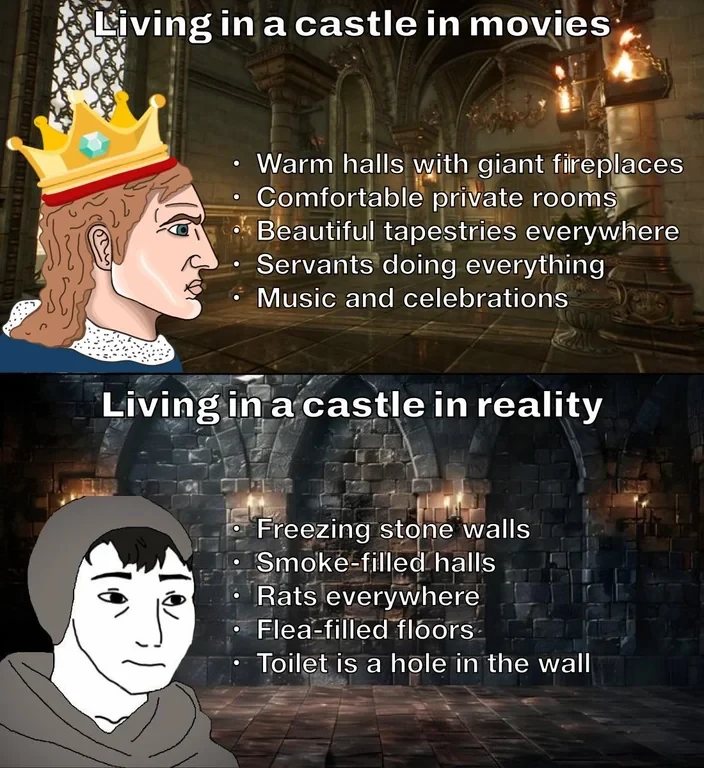

Now, now. You can’t just call it un-comfy just because of that.
Compare it to a ‘comfy’ home in the same era, which has:
-
Drafty wattle-and-daub walls and leaky thatch roof
-
Smoke filled rooms
-
Rats everywhere
-
Flea-filled floors, walls, and ceiling
-
Toilet is a hole in the ground outside
-
In this case the movie version is closer to reality than your “realistic” version. Castles were not just built for defensibility. They have a strong representative aspect. Of course they made them as nice to live in as possible. The walls were covered in tapestries or wood panelling and many rooms were heated. For unheated rooms there were movable heaters (basically small portable fire pits).
Heres an example of a hall in a castle: https://de.wikipedia.org/wiki/Très_Riches_Heures#/media/Datei:Les_Très_Riches_Heures_du_duc_de_Berry_Janvier.jpg
Castles were overwhelmingly built for defensibility until the 16th century, at which point you see more of a mixture of elements; and then fortresses emerging as predominantly military again in the 17th century. Royal lodgings and other such estates which would have had more amenities were generally not seriously fortified, and thus are not castles in any traditional sense.
You gave it exactly backwards. The castle is by definition the combination of residence and fortification. The purely military fortress only really developed after the medieval period.
Not at all. The notion of a purely military fortress in the sense of being primarily for the permanent garrisoning of troops only really developed after the medieval period.
Castles were overwhelmingly and in many polities exclusively built for defensive purposes, with the ability to reside in them being only an extension of that insofar as you can’t hold out against a siege if you can’t live there for at least a few nights. It’s why permission to build a castle in the first place is so often restricted by medieval law, requiring the direct assent of the monarch in most medieval polities.
Sure the toilet is a hole in the wall, but it beats shitting in the moat.
Toilets inside the castle itself would empty into an internal cesspit, sure, but if the toilet was on the curtain walls, it probably empties into the moat anyway.
… don’t fall in.
I have extensive experience with castles and this does not mention they are very bouncy & come with slides
I bet there was a comfy room or two for the nobs.
You might be surprised! Especially before the Renaissance, many nobles wouldn’t even have their own private rooms in castles. Space is at a premium! Later medieval castles would often have a single ‘solar’ for housing the lord and his entire family, which were a bit comfier, but only a bit.
It’s all about defense, baby!
Castles aren’t only about defense. They are home, court, symbol of power, etc. A castle is a combination of residence and fortress. Bith parts are equally important.
There weren’t many private rooms, just as in every home in the time. Doesn’t mean it wasn’t comfy.
Castles aren’t only about defense. They are home, court, symbol of power, etc. A castle is a combination of residence and fortress. Bith parts are equally important.
No, they really aren’t. Castles are fortifications; that’s the defining feature of the term. It’s residential features are distinctly secondary. Most Lords who owned castles did not reside in them year-round - the mobility of nobility through their estates is commonly recognized in writing on the medieval period; the notion of a centralized court doesn’t come about until the late medieval period, and then most strongly in royal courts, and even then not universally.
You seem to have a really outdated understanding of castles. A castle is not a fortress.
Yes, nobility was mobile at that time, but how exactly does this and the absence of a centralised court contradict the representative, residential and administrative function of castles in any way?
You seem to have a really outdated understanding of castles. A castle is not a fortress.
Bruh. A castle is literally a kind of fortress. You yourself call it a combination of a residence and fortress; but no fortress exists without the ability to reside in it, so either no fortresses exist that have any form of barracks, hall, or solar, or you need to re-examine your own terminology.
Yes, nobility was mobile at that time, but how exactly does this and the absence of a centralised court contradict the representative, residential and administrative function of castles in any way?
Breathe in, breathe out.
Who would sacrifice a castle’s defensibility for personal comfort when they spend most of their time elsewhere than the castle?
I at no point dismissed the administrative functions of a castle, and I’ll thank you not to extend my argument further than the point about being primarily fortifications and not ‘equally’ residence and fortress.
Who would sacrifice a castle’s defensibility for personal comfort
And why exactly is heating and furnishing a castle decreasing it’s defensibility? The castle is where you meet other nobles, hold court (even if not centralized) and have all kinds of other representative events. Reputation is extremely important in medieval nobility, so it is important that your castle is not a cold, dark shithole.
Where exactly do you think those nobles spent all their time? When they were not in their own castle, they were likely in someone else’s.
And why exactly is heating and furnishing a castle decreasing it’s defensibility?
Because both of those things are expensive, requiring furniture, supplies and space. The third being the most relevant in this case - as mentioned, even solars are only a later development, and not particularly comfortable.
The castle is where you meet other nobles, hold court (even if not centralized) and have all kinds of other representative events.
Other nobles are generally not attending your court, only your vassals would attend; and your vassals would not be thrilled to be constantly called to court unless you were immensely powerful compared to other nobles to begin with. A castle isn’t a place to ‘hold court’ because ‘court’ in any real sense below the level of royalty is held wherever the overlord goes, and the overlord goes from estate to estate in order to administer his estates. Fuck, man, there are English kings - with England’s centralization being quite extreme by medieval standards - with immediate vassals who never met them over the course of their entire reigns, at court or otherwise.
The medieval world is much less connected than you’re imagining, at least for the vast majority of the nobility.
Where exactly do you think those nobles spent all their time? When they were not in their own castle, they were likely in someone else’s.
They largely spent their times in one of their many manors, generally not what we would recognize as a castle. Wealthier individuals would have dedicated lodgings which go by numerous names, but were generally also unfortified, especially hunting lodges and townhouses.
The acoustics in those castles must be horrendous too. Just shit echoing all over the damn place
That’s what the tapestries are for
Don’t forget that the benefit of being a noble was sleeping in a big group on a cloth covered sack of hay in some filthy flea-bitten body odor nest.
Your sack of hay is covered in cloth? Truly unbelievable luxury. We poor peasants oft cannot even afford a sack and must sleep on bare hay alone.
And, sure, you share it with other nobles. But at least you aren’t sharing it with the pigs as well.
It must be warm inside to attract the rats
Just being slightly warmer will accomplish that; it can still be freezing.
Not to mention the presence of food stores.