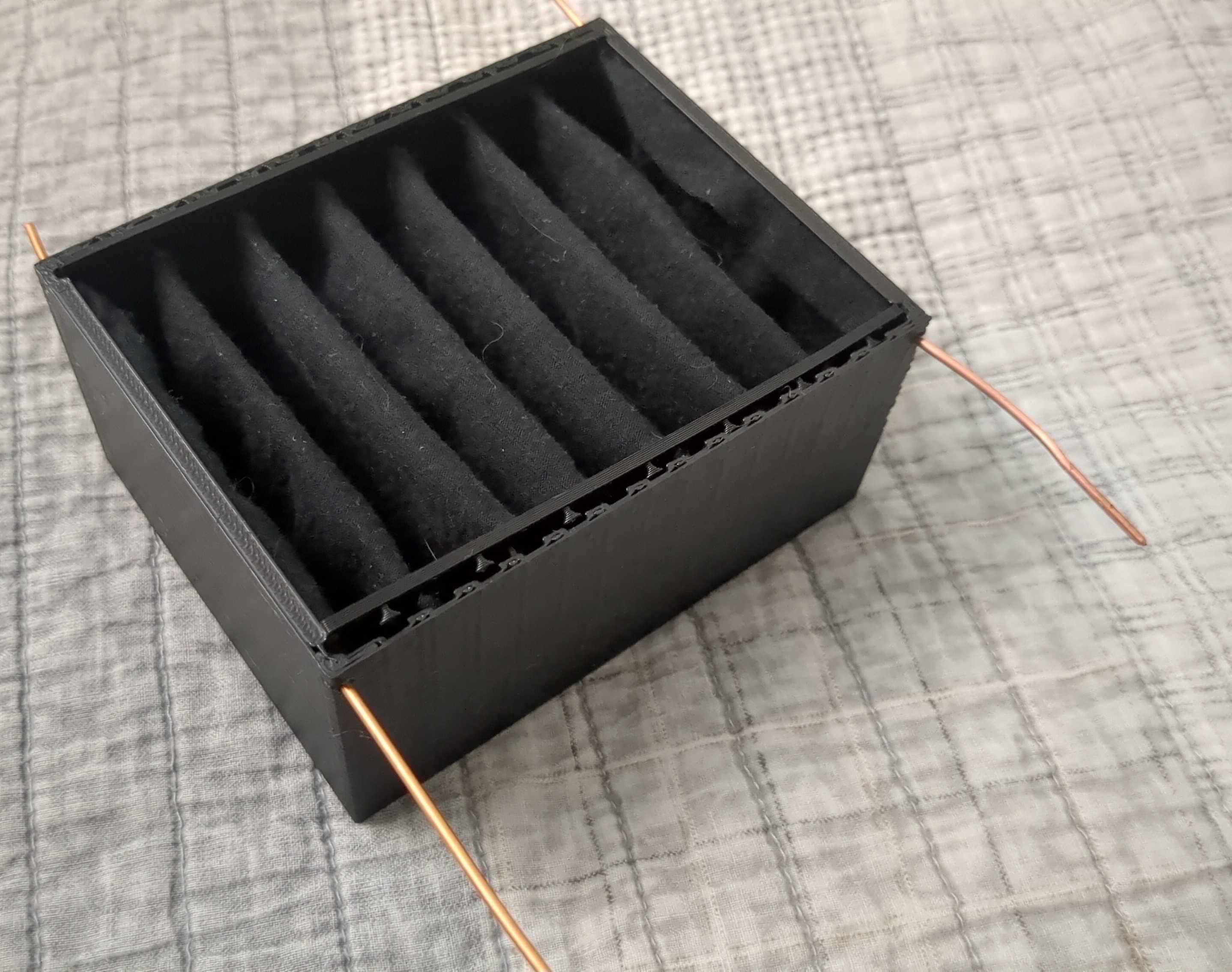
I failed again on a couple of levels, but am figuring out the problem…

I think for the next design I am going to attack each pleat segment as an assembly like a Lego build. I need to shape the pleat and secure both top and bottom in a way that allows the fabric to pass through the ends. Then mount that brick assembly into a frame that pulls tension along the pleat length.
I’m kinda at a mental impasse at the moment because the alternative idea I have is to melt a bead of PLA into the top and bottom edge of the fabric to allow assembly with the fabric already cut to length.
With the Lego bricks-like clipping assembly, the conundrum is how to trim the excess and still create a filer frame that is easy to build into a larger air box assembly.
My goal is to have taut pleats with no cardboard or material forming them. This is actually a second project and attempt at such a thing. I could easily buy something, but screw that. Amazon won’t list dimensions of filters because that would be honest, when branding is exploitable for price fixing. I would rather cut up an old tee shirt for a better filter media anyways, or toy with more complexity in sensors with a microcontroller or filtration media later down the road.
You must log in or # to comment.
Spray glue maybe?
Adhesives are how most mass produced filters appear to be made. Creating an assembly is surprisingly complex. It is not easy to fold the pleats evenly AND get them taut in two directions.
One cool side effect is that any mechanical assembly would likely relate to the automated machinery and mechanisms that are needed to build a pleated filter with adhesives.
I wouldn’t spray anything around an air filter medium like this. I would do stuff like dipping an edge into an adhesive and apply that edge to a frame. Then let this cure before further forming operations.
I also wonder about a layer on top of the media perhaps
You’d be making a K&N style filter then. It requires two sets of pleated fine mesh, with 5-8 layers of medical gauss formed between the mesh. Fabric doesn’t conform well in a mesh like this. I have tried it before. The gauss has enough loose conformity to work, but it lacks the higher thread count of most textile fabrics and usually requires some kind of oil on the gauss to attract smaller particles without passing most of them.