

We all know the pictures of the astronauts on the ISS floating around. We also suspect that a lack of gravity is bad for the body as the muscles go weak and such.
Why don’t spaceships just rotate to cause the effect of artificial gravity through centrifugal forces?
The ISS is primarily designed to research the effects of microgravity and other space environment issues. Hard to study zero g manufacturing when your station has artificial gravity.
True
Small ships would have to rotate really fast to make 1G, and it’s not worth the trouble if nobody lives there permanently.
Even if a small ship rotates fast that would ‘t work. If you have a small diameter then there would a huge difference between the perceived ‘gravity’ at your head vs at your feet.
Not to mention the coriolis effect wreaking havoc on your inner ear.
Not a problem when you’re sleeping lying down.
 93·1 month ago
no, but the force of the rotation squeezing most of your blood into your head or feet might be a problem for you
Why? It’s still just 1G.
Do you faint when descending in an elevator?
Why? It’s still just 1G.
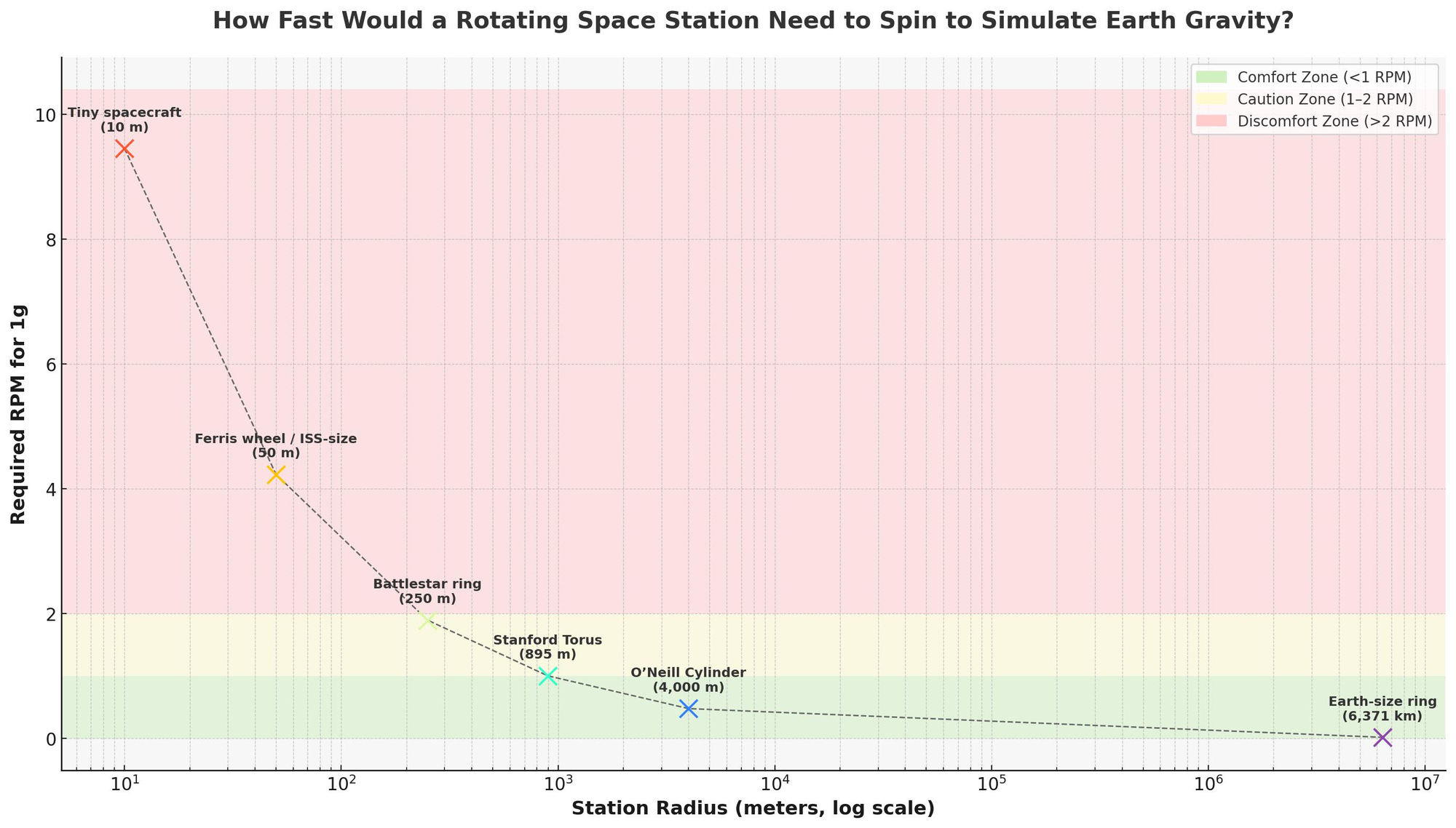
what is this data based on?
https://ntrs.nasa.gov/api/citations/20070001008/downloads/20070001008.pdf
At body motions or centrifuge rotation rates that are small in magnitude, the effects of the Coriolis force are negligible, as on Earth. However, in a centrifuge rotating at several rpm, there can be disconcerting effects. Simple movements become complex and eye-head movements can be altered: turning the head can make stationary objects appear to rotate and continue to move once the head has stopped. This is because Coriolis forces also create cross-coupled angular accelerations in the semicircular canals of the inner ear (see Figure 4-01) when the head is turned out of the plane of rotation. Consequently, motion sickness can result even at low rotation rates (<3 rpm), although people can eventually adapt to higher rates after incremented, prolonged exposure (see Chapter 3, Section 3.1).
You said force of rotation but the chart is talking about RPM.
Still only 1G.
You said force of rotation but the chart is talking about RPM.
yes, you have forgotten to take into account the Coriolis force and the effect it would have on your astronauts.
https://ntrs.nasa.gov/api/citations/20070001008/downloads/20070001008.pdf
At body motions or centrifuge rotation rates that are small in magnitude, the effects of the Coriolis force are negligible, as on Earth. However, in a centrifuge rotating at several rpm, there can be disconcerting effects. Simple movements become complex and eye-head movements can be altered: turning the head can make stationary objects appear to rotate and continue to move once the head has stopped. This is because Coriolis forces also create cross-coupled angular accelerations in the semicircular canals of the inner ear (see Figure 4-01) when the head is turned out of the plane of rotation. Consequently, motion sickness can result even at low rotation rates (<3 rpm), although people can eventually adapt to higher rates after incremented, prolonged exposure (see Chapter 3, Section 3.1).
in other words, the higher the RPM needed to generate 1g, the worse the effect of the Coriolis force on the astronauts.
Everyone is doing a terrible job of explaining, but they’re right.
Gravity, 1G, is described on terms of an acceleration. 9.81m/s2.
What is an acceleration? Is is the rate of change of a velocity. If a velocity changes slowly, it means the acceleration is low. If the velocity changes quickly, the acceleration is high.
Now, imagining a record player. Or cd player. Or your spinning wheel of choice:
You know that points farther away from the center are moving faster in absolute terms compared to points closer to the center.
Because the points farther from the center have a larger velocity, that means after some rotation, the total change of velocity for the outer points must be larger than the change of velocity for inner points. So, points farther away must have greater acceleration.
So, the apparent acceleration changes according to how far things are from the center point. This is why it really isn’t the case that it would be 1G everywhere. 1G is a specific acceleration, if if we’ve established that acceleration isn’t constant across the radius, then it can be 1 G only at one spot, not all.
Elevators don’t cause a pressure differential within your body.
Im not really sure what you mean by lying down? You’re not always lying down. Surely gravity is less relevant when you’re lying down anyway.
… I dont have a good understanding of physics but sci-fi novels suggest a few problems on small ships.
The first problem is the difference in gravity between your feet and your head. In a small command capsule like Artemis 2, your head might be near the centre at 0g while your feet are at the outside at 1g or even 2g. How hard does your heart need to pump blood? Would this create some kind of blood pressure problem?
The next problem is how it would “feel”. Is it called the Coriolis effect?
In a small ship you might experience 1g, but it would feel like you’re being spun around in a washing machine. Your ears would tell you that you’re constantly changing direction and it would 100% fuck you up. In sci-fi the spinning thing needs to be large enough that some g-force is produced without you feeling that sense of motion, or at least for ot to be small enough that you get used to it.
Another problem I just made up is that if there’s no gravity then 100% of the inner surface area can be terminals and readouts and equipment. If you create gravity then you need a floor to walk on which will use a heap of surface area.
There was recently a “design proposal” (more of a published thought experiment) I read (posted on lemmy) where the authors had figured out the diameter required such that the gravity differential from feet to head wouldn’t be weird. It was quite large if I recall.
I guess thats why, in sci fi it’s only used on ring shaped objects. A ship with a ring around its mid section, or a space station, or the expanse has a barrel shaped ship.
interestingly bigger ships would have to rotate faster than small ships to achieve 1g btw
this is due to smaller ships having a larger curvature so less velocity is needed
edit: no wait i just did the maths again and you’re right. smaller ships need lower absolute velocity of the outside walls, but angular velocity is higher.
Yes, but the smaller the ship, the worse the Coriolis force will be. Imagine a 10m corridor with opposing gravity on each end, and no gravity in the middle. Travelling across would be extremely disorienting.
i think that would be so much fun!
Now I’m thinking about how much force you would need to be able to jump high enough to hit escape velocity on your side, do half a flip, and land on the other…
I did the calculation somewhere else in this thread, the outer walls of the spaceship (diameter 9m) would rotate with 24 km/h, so if you run really fast, you can outrun the rotation and start to float.
Edit: a healthy adult should be able to sprint 100 m in 15 seconds, which is precisely 24 km/h. Source.
Ooh! I didn’t think about outrunning the rotation! Seems like there’d be a curve to your speed there as each bit of acceleration would make you lighter, making it easier to run… Like the rig they used in the marvel movies to make Captain America outrun everyone.
lol you’re right actually :p
Key goals for both moon and mars missions is finding out how much gravity we need. We know we’re much healthier at 1G than in microgravity, but where is good enough? You can’t really draw a straight line to predict it. Does the moon have enough gravity for people to stay healthy long term? Does mars? Where should we set the rotation of a space station with artificial gravity?
Basically, the spinning diameter has to be really long so the spinning doesn’t make you puke long-term (Coriolis force is a bitch). There were NASA tests and studies about it, which range between a 100 and a 1000 meter diameter.
So, the ship has to be built for it from the design phase, be it with a rotating ring or a tether approach. Which we didn’t have yet a usecase for (for only a few days or months):- For a future Mars mission, would slow acceleration and deceleration be more viable.
- Only real fitting usecase is a orbital space station with permanent crew.
Because it’s expensive.
You have to build equipment to withstand constant load, which is much heavier, which means more launches and launches are more expensive.
Suddenly there is a greatly reduced working and living area. You go from being able to work in any surface to only surfaces near the “floor”. So you need to build more areas, and the architecture becomes more complex, both requiring many more launches.
A lot of the things you want to do in space, like science experiments, have to do with micro gravity, so introducing artificial gravity would make space stations kind of pointless.
To make the structure big enough to spin comfortably would require a very large structure, which means a lot of material, and a lot of launches. And more places for things to go wrong, so a lot more engineering and safety assurance is required.
It is primarily the latter reason. Rotating e.g. the capsule of the Artemis mission in a way that would produce enough fake gravity would be… interesting. And the astronauts’ feet would have gravity, while their heads would not.
Yeah that is a large part, but I don’t wanna minimize the other parts, because they all mean you need a significantly larger vehicle rather than “just” a counterweight.
Well if they’re spinning, center of the spin would still have micro gravity.
Yes, but thats a small area compared to the entire station.
We haven’t done anything worthy of the effort to build a ship that’s capable yet, basically.
You would need a pretty large radius to generate stable rotational gravity. If the radius is too small, the speed of rotation would make standing or walking nearly impossible. The larger the radius, the more imperceptible the rotational effects would be.
ok so i did some calculations:
If your ship is 9 m in diameter (just chosen at random, not because Starship is by chance 9 m in diameter)
that means x = r*cos(omega*t) and x’’ = r*omega^2*-cos(omega*t) = 1g for t = 0 implies r*omega^2 = 10 m/s², r ≈ 4.5 m, omega ≈ 1.5 rad/s
so the ship would have to rotate with roughly 0.24 rotations per second or 14 rpm. seems doable to me. the outer walls would move with 6.7 m/s or 24 km/h.
Doable, not practical. Another major concern is the induced dizziness and general discomfort from such a small circumference. If you stand up straight, your head moves significantly slower than your feet. There are more effects that humans don’t do well with.
In addition keep in mind that this implies significant mechanical complexity the moment you don’t rotate the whole craft, but only a section or ring. If you do rotate all of it, simple tasks like taking a photo become… cumbersome.
Also like others have said, it’s not a permanent residence for anyone, and the main goal of the ISS is the study of low- or micro-gravity.
Have you ever been in one of these?
You can easily sit on the wall while it’s spinning, and it actually feels pretty normal. But, if you try and stand up and walk around…you’re going to have a very bad day.
For some reason your link didn’t work for me - in case it helps anyone else, here’s the link again:
Thank you.
actually i have been, and i have attributed it to the device not providing consistent centrifugal forces. instead, gravity interferes and makes it inconsistent. which would not happen on a spaceship.
14 rpm. seems doable to me
LOL of course it is doable to create rotation. But is it no good if living there is still unbearable.
I recommend you do some sea traveling, just a few months on a cargo ship on several oceans.
Here is a great video on spin gravity. It covers an important detail that another comment mentions but most over look. Spinning fast enough to create gravity-like centrifugal force causes real dizziness at small diameters. 5 or 6 rpm is about the maximum we can stand.
That’s why you split the ship in two and spin the habitation module around the heavier part of the ship¹, connected by a tether, as in Project Hail Mary (which the video says is still too fast… so just make the tether longer).
- Well, around their common barycentre, but you know what I mean.
Yeah, a good idea. You run into some material strength issues, but I think this is the way.
We just need to breed two or seven generations of humans in tiny ship orbit and they will adapt.
There’s a rotating spaceship in a parking lot in Japan. 20 years ago NASA paid Japan to build the Centrifuge Accomodations Module for the ISS, but Congress cut the $100m it was going to cost to launch it, so it’s next to some bushes with bird poop on it.
As some have already mentioned - coriolis forces. But why not build bigger so coriolis forces aren’t an issue? Because spinning up anything of sufficient diameter to even come close to 1G would need some kind of unobtainium to be strong enough to keep the spinning object intact. Say 5 tons of mass at 0 G is just mass, but now accelerate it and you need to figure out how to support 5 tons.
1 rpm for 1 G is going to need almost 1km radius. 2 rpm is ~400m.
You can see that the numbers, size, and engineering get pretty ridiculous to keep people from being sick when spun.
Because it would be less fun
especially the toilet
It helps reduce the problems mentioned if you lessen the target goal. We don’t need 1 G of force just like we don’t need a full 1 atm or pressure or 80% of nitrogen mix in the air to breathe. Less gravity force, less RPMs for the same diameter.
But scale is still the better option, making something a few kilometers wide and with only 0.7 G means less stress, less effects from the rotation, etc. That’s still in the category of megastructures though, so while not impossible to build, not going to happen at our current level.
yeah 200 mbar of oxygen should be fine, also 0.3g if we’re gonna land on mars eventually we might as well get used to the gravity level.
lol did you just watch Project Hail Mary?
deleted by creator
no? never heard of it
It’s a book / movie that just came out where the operators of a spaceship continually turn artificial gravity on and off by using spinning to create centrifugal force. I’m assuming there are recently a lot of people wondering this same question.
the one in space odyssey did.
In The Martian, the hermes ship used to go between Mars and the Earth used this method. In the hail Mary Project the ship split in two halves joined by cables to replicate earth gravity, by separating the two halves by large distance.
It’s a Sci fi concept so far, there must be a reson it’s not implemented.
ISS has thrusters that push it up/ forward from time to time. It’s practically permanently falling on / around earth, to create the lack of gravity. Up there gravity is nearly pulling as strong as here